
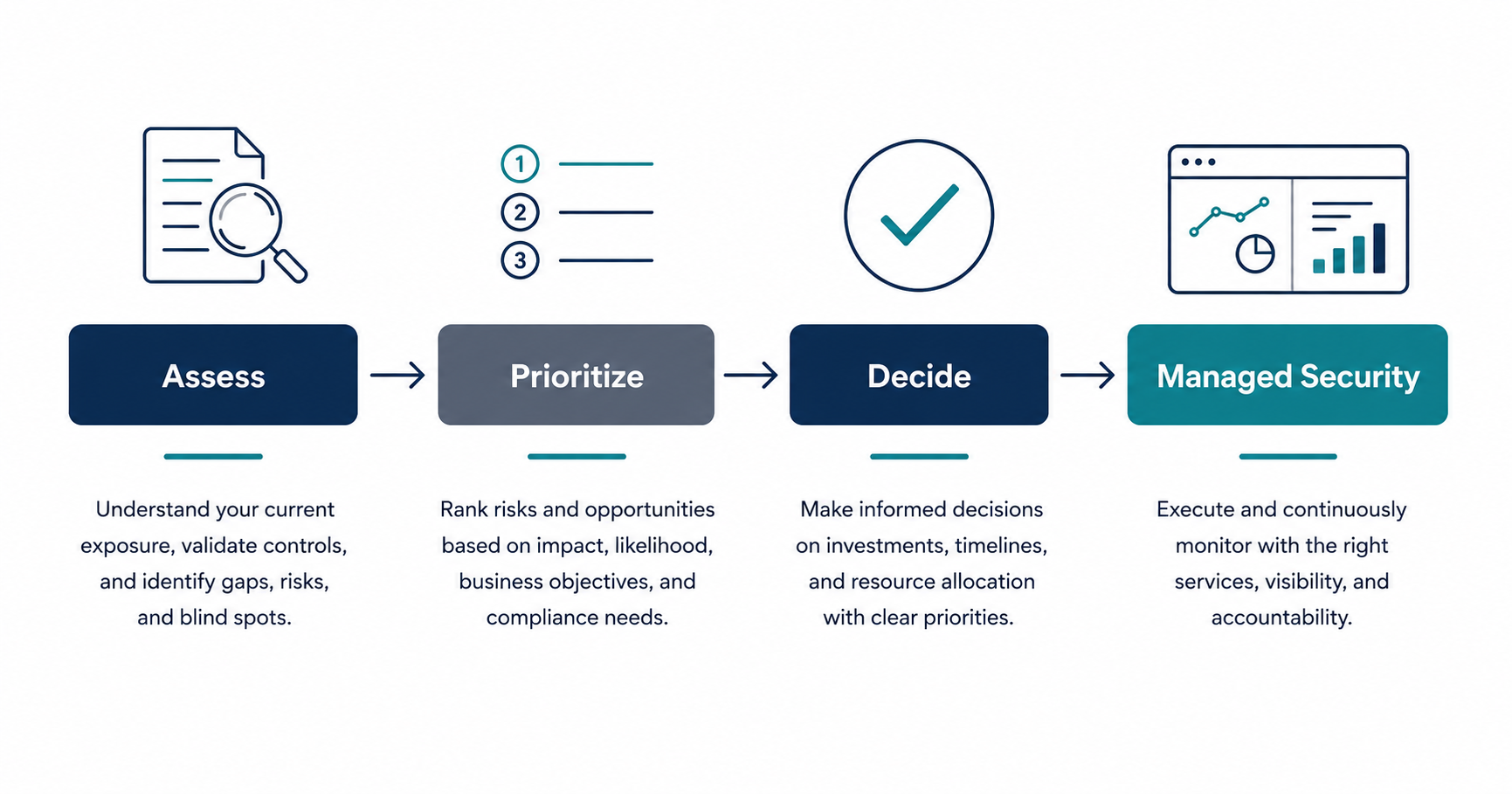
When leadership teams decide it is time to strengthen cybersecurity, the conversation often begins with a purchase. Should we outsource monitoring? Do we need managed detection and response? Should we replace the SIEM? Do we need 24/7 coverage? These are reasonable questions, but they are rarely the first questions an organization should answer.
For organizations operating in regulated and operationally sensitive industries, the more responsible starting point is a cybersecurity assessment for regulated organizations that clarifies the current state before any ongoing service is selected. An assessment helps leadership understand what is actually exposed, what is working as intended, where visibility is limited, and which risks deserve immediate attention. Without that baseline, an organization can spend real budget monitoring the wrong assets, overlook operational dependencies, or reinforce assumptions that were never validated.
Assessment-first cybersecurity is not a delay tactic. It is the step that makes every later investment more effective, more defensible to regulators and boards, and more closely aligned with how the business actually operates.
There is also a practical reason to slow down at the start. Security budgets in regulated organizations are scrutinized by boards, auditors, and regulators, and every dollar spent should map back to a clearly understood risk. When a purchase is made before the environment is understood, leadership often cannot explain, in business terms, why that spend was the right priority. An assessment gives leadership that explanation in advance. It turns a security purchase from a reaction into a decision that can be defended in a board meeting or an audit.
Managed Security Cannot Solve Problems You Have Not Identified
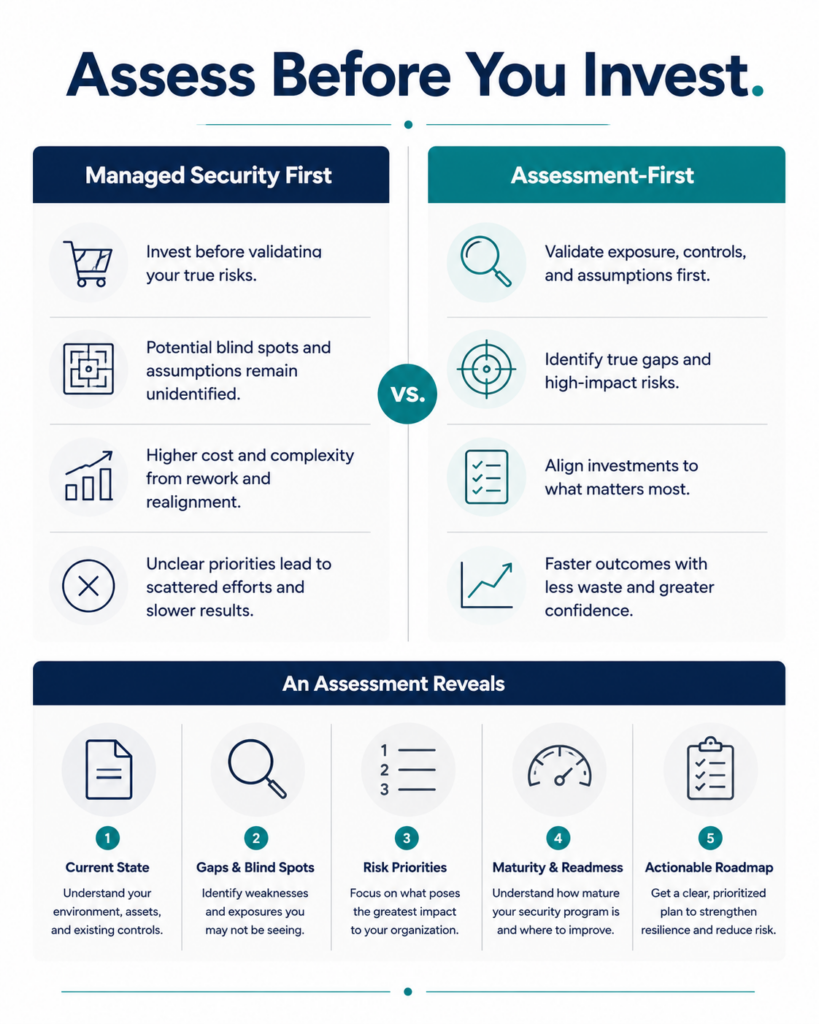
Managed security services extend an organization’s ability to monitor, investigate, and respond. They are valuable, but they are most effective when they are built on an accurate understanding of the environment they are protecting. A managed service inherits whatever gaps already exist. If critical systems are missing from the asset inventory, if monitoring coverage has quiet blind spots, if vendor access is poorly understood, or if governance is inconsistent, then even a well-run service will operate on an incomplete picture.
A security gap assessment is designed to surface exactly these issues. It answers foundational questions before money is committed:
- Which assets are most critical to operations, and are they all accounted for?
- Which systems are actually monitored today, and which only appear to be?
- Where are the largest visibility gaps across IT and operational technology?
- Which existing security controls are functioning as intended?
- Which leadership assumptions have never been independently validated?
This approach reflects the intent of the NIST Cybersecurity Framework (CSF) 2.0, which encourages organizations to understand their current profile, define a target profile, and prioritize improvements through risk-based analysis before broad implementation. CSF 2.0 also introduced the Govern function, which frames cybersecurity governance and executive accountability as business responsibilities rather than purely technical ones.
You can review the framework directly at: https://nvlpubs.nist.gov/nistpubs/CSWP/NIST.CSWP.29.pdf
What a Cybersecurity Assessment Actually Evaluates
A meaningful cyber risk assessment goes well beyond a vulnerability scan. Scanning tells you where certain technical weaknesses exist. An assessment tells you what those weaknesses mean for the business, how they relate to one another, and which ones matter most given your operations and obligations.
A comprehensive assessment typically examines:
- Asset visibility: whether the organization has an accurate, current inventory of systems, data, and connections.
- Vulnerability exposure: where known weaknesses exist and how they map to critical operations.
- Identity and privileged access: who can access what, and whether that access is appropriate and monitored.
- Monitoring coverage: which systems generate usable telemetry and which are effectively invisible.
- Incident response readiness: whether plans reflect the current environment and whether people know their roles.
- Third-party and vendor access: how external providers connect and what risk they introduce.
- Security governance and reporting: whether leadership receives information that reflects real operational risk.
- Operational dependencies: how a disruption in one system would affect the wider business.
- Compliance readiness: how current practices align with regulatory expectations.
The output should not be a long list of findings with no context. A useful assessment produces a prioritized roadmap that helps leadership decide what to address first, what can wait, and where existing investments can be strengthened before new ones are added.
The distinction between a scan and an assessment matters most when resources are limited, which is nearly always. A scan might return hundreds of findings ranked only by technical severity. An assessment weighs those findings against what the organization actually does: which systems support revenue, which support safety, which are subject to regulatory reporting, and which are exposed to third parties. The result is a shorter, clearer set of priorities that leadership can act on without needing to interpret raw technical output. This is also where a cyber risk assessment supports governance directly, because it gives executives and boards a defensible basis for the decisions they approve.
Why Regulated Organizations Face Different Risks
Regulated organizations rarely treat cybersecurity as a purely technical concern, because in these environments a cyber event can affect continuity, compliance, safety, and public trust at the same time. The specifics differ by sector.
Banking and Financial Services
Financial institutions operate under sustained regulatory attention and depend on the continuous availability of payment systems, core banking platforms, and customer-facing services. A disruption can affect transactions, reporting obligations, and customer confidence at once. Many institutions also rely on a web of third-party providers for payments, cloud services, and fintech integrations, which expands the number of connections that need to be understood. A cybersecurity assessment for regulated organizations in this sector helps leadership confirm which systems are genuinely monitored, how vendor connections are managed, and whether controls would hold up under both regulatory review and real operational stress.
Maritime and Port Operations
Maritime and port organizations combine information technology with operational technology across vessels, terminals, cargo handling, navigation, and communications. These environments often include long-lived systems that were not originally designed with connectivity in mind, and disruptions can affect the physical movement of goods, not just data. Because operations are distributed and frequently run outside standard business hours, visibility and after-hours response are recurring concerns. A cyber risk assessment in this sector focuses attention on the dependencies between IT and OT, the exposure of remote and shipboard systems, and the readiness to respond when an incident affects operations rather than only office networks.
Casino and Tribal Gaming
Casino and tribal gaming organizations run unusually broad and interconnected environments that span gaming systems, hospitality and hotel operations, surveillance, payment processing, loyalty programs, and guest services. They also operate under specific regulatory and, in the case of tribal gaming, sovereign considerations. Because so many systems touch payments and guest data while running continuously, a weakness in one area can affect several others. An assessment-first cybersecurity approach helps gaming leadership understand which of these interconnected systems are monitored, where segmentation is weak, and how an incident in one function could cascade into others.
Other Regulated or Operationally Sensitive Organizations
Healthcare providers, utilities, critical infrastructure operators, and similar organizations share a common characteristic: cybersecurity is tied directly to safety, continuity, and compliance. For all of them, understanding operational dependencies is as important as identifying technical vulnerabilities. The starting point is the same. Validate what is known before expanding what is bought.
Common Leadership Assumptions That Should Be Validated
Many organizations believe they already have adequate visibility because they have invested in modern security tools. An assessment frequently shows a more nuanced picture. Common assumptions worth validating include:
- We have identified every critical asset.
- All important systems are monitored and generating usable data.
- Vendor and third-party access is appropriately controlled.
- Incident response plans reflect the environment we operate today, not the one we had two years ago.
- Executive reporting accurately represents real operational risk.
An independent assessment either confirms these assumptions, which is reassuring, or challenges them before they become business problems, which is far less expensive than discovering the gap during an incident.
This mirrors the guidance in CISA’s Cybersecurity Performance Goals (CPGs) 2.0, which encourage organizations to maintain a current asset inventory, validate controls, manage risks associated with managed service providers, and establish governance that supports leadership oversight.
The full set of goals is available at https://www.cisa.gov/cybersecurity-performance-goals-2-0-cpg-2-0.
These recommendations reinforce a simple point: understand the environment before expanding operational security services on top of it.
How Assessment-First Cybersecurity Improves Managed Security Outcomes
Choosing to assess first does not mean managed security is unnecessary. For many regulated organizations, managed detection, monitoring, and response become important parts of a mature program. The point is sequence. Managed security should be built on validated knowledge rather than assumptions.
When an assessment comes first, managed security is easier to scope and more effective in practice. Leadership can:
- Prioritize investment toward the risks that matter most to operations.
- Ensure monitoring coverage reflects the true critical asset list.
- Strengthen governance and reporting so oversight is meaningful.
- Identify operational blind spots before a provider inherits them.
- Reduce spending on capabilities that do not address real exposure.
- Align every security initiative with business priorities and regulatory obligations.
Importantly, this approach reinforces internal teams rather than replacing them. An assessment gives internal IT, security, and compliance staff a shared, evidence-based view of where outside expertise or additional services will add the most value. In many organizations, technical staff already suspect where the weak points are, but they lack an independent, prioritized document that leadership will act on. An assessment provides exactly that. It validates the concerns internal teams have raised, adds structure, and connects those concerns to business outcomes that executives recognize.
The sequence also improves the relationship with any managed security provider that is eventually selected. When a provider begins with an accurate asset list, a clear understanding of critical systems, and a defined set of priorities, onboarding is faster and monitoring is tuned to what matters. When a provider is asked to protect an environment no one has fully mapped, the first months are often spent rediscovering what an assessment would have documented at the outset.
How The Saturn Partners Approaches Cybersecurity Assessments
At The Saturn Partners, managed security is never presented as a one-size-fits-all product. Every engagement begins with understanding the organization’s operating environment, regulatory obligations, existing capabilities, and leadership priorities. That context shapes everything that follows.
Our assessments are designed to help regulated organizations answer practical questions in plain language:
- What is actually exposed right now?
- What is being monitored, and what only appears to be?
- Which assumptions have not been independently validated?
- Which risks deserve immediate attention, and which can be scheduled?
- Where can existing investments be strengthened before new ones are added?
This advisory-led, assessment-first approach gives leadership the visibility needed to make informed decisions rather than reacting to the latest trend or purchasing technology without context. Whether the next step is governance work through a vCISO engagement, targeted vulnerability assessment work, improved incident readiness, or managed services, the decision is grounded in evidence.
Conclusion
Managed security can be a valuable part of a mature cybersecurity program, but it should not be the first move. The responsible first step for a regulated organization is to understand the current environment, validate leadership assumptions, and identify the risks that matter most to operations, compliance, safety, and continuity.
Assessment-first cybersecurity creates a stronger foundation for every decision that follows, whether that involves governance, vulnerability management, incident readiness, or managed security. If your organization operates in a regulated or operationally sensitive environment, beginning with a cybersecurity assessment helps ensure your next cybersecurity decision is based on evidence rather than assumptions.